
Why Magnesium Threonate Made a Difference in My Brain & Sleep
This post may contain affiliate links. If you choose to purchase through them, I may earn a small commission at no extra cost to you.

The Night My Brain Finally Slept
I caught a virus.
Not that virus—the infamous one we all remember
It was something strange.
At night, my muscles would twitch like they were trying to send Morse code from another dimension.
I called my doctor, and after a few questions, he said, “You’re fine—healthy, normal, nothing to worry about.
But this virus might be playing tricks on your nervous system.
It can sometimes trigger mild seizures.”
“What?” I practically shouted.
He smiled calmly, like this was just another Tuesday.
You can go to the ER and ask for an IV of magnesium. It works wonders for preventing seizures.
What? I yelled again, mouth still hanging open.
Or, he said, grinning now, you could just try the supplement form. Take it orally. Works too.
When I finally managed to lift my jaw off the floor and back into its proper place, I decided supplements were a much safer bet than the whole ER drama—and definitely kinder to my wallet and my karma (which, frankly, I’d like to keep intact for at least three future generations).
By the second night on Magnesium, the pre-seizure twitches that haunted my sleep were gone.
Five days later, I stopped taking it—just to test myself—and within two nights, the shadows crept back.
That’s when I realized this mineral wasn’t hype.
It was almost magical.
The Quiet Brain Fix No One Told Me About
I expected better sleep.
I didn’t expect the clarity either.
My thoughts sharpened, my focus came back, and my moods stopped swinging like a tired metronome.
It wasn’t a jolt of energy—it was as a steady light.
If you’ve been feeling off lately — foggy, moody, wired but tired — it might not just be life catching up with you.
It might be your brain asking for support.
Common clues:
Random body jerks or restless sleep
Mood dips that feel unprovoked
Forgetfulness or mental static
Stress reactions that feel too loud for the situation
That’s where this form of magnesium comes in. Unlike other forms, this one can actually cross into the brain—the place where calm begins and clarity lives.
What Makes It Different
I like to think of the brain as a city at night.
Everything is running at once.
Signals. Memories. эмоtions. Repair systems.
Lights on everywhere.
The problem is that most nutrients never really make it into that city.
They circulate around the edges.
They support the body.
But the brain stays under-resourced.
This form of magnesium is different.
It’s one of the few that can actually pass through the gates and work where it matters most — communication, learning, repair, resilience.
Most diets don’t deliver enough magnesium to make a noticeable difference.
And most supplements don’t either.
This one does.
And you feel it.
Not like caffeine.
Not like sugar.
More like remembering what peace feels like inside your own head.
The calm that doesn’t stimulate you.
It just gives your mind permission to rest again.
What this Form of Magnesium Really Does
I didn’t need a lab coat to notice what this mineral was doing for me.
I felt it first.
In my sleep.
In my focus.
In the way my mind stopped feeling so… crowded.
The science just happened to confirm what I was already experiencing.
Research from places like MIT and other research centers has shown that this specific form of magnesium can:
Sharpen memory and recall.
Improve focus and mental clarity — which, honestly, I didn’t even realize I was missing.
Calm the nervous system for better sleep and steadier moods — something I knew I needed for a long time.
Support neuroplasticity — the brain’s ability to grow and adapt, even when life keeps telling us we’re “too old for that.”
And that last one is the part that really stayed with me.
Because it reframes everything.
Your brain isn’t declining.
It’s responding to its environment.
And when you give it the right support,
it doesn’t just function.
It wakes up.
In short?
It helps your brain feel alive again.
What the Research Actually Says
This type of Magnesium isn’t some shiny new wellness buzzword—it’s been quietly studied for years.
2010, MIT: Showed that it increased synaptic connections in the hippocampus—the part of the brain that handles memory and learning.
2016, Clinical Pilot Trial: Adults with mild cognitive decline showed noticeable improvement in memory and executive function.
2019, Animal Study: Linked this form of magnesium to calmer behavior and deeper sleep cycles.
2022, Scientific Review: Highlighted its potential to support healthy aging and protect the brain over time (though yes, we still need more human trials).
The takeaway? Among all the magnesium types out there, this one actually crosses into the brain. That’s where the magic happens—where clarity, calm, and creativity begin to rebuild themselves.

Who Might Benefit from it
Every brain has its own rhythm.
Different needs.
Different stress thresholds.
Different ways of responding to the same world.
But both research — and a fair amount of personal experience — suggest this form of magnesium can be especially helpful if you recognize yourself in any of these:
If your mind feels foggy.
Forgetful.
As your thoughts were moving through molasses instead of air.
If you toss and turn at night.
Or wake up feeling more wired than rested.
If stress hits you harder than it used to.
If small conflicts feel bigger.
If emotional dips arrive without much explanation.
If you’re moving through perimenopause, menopause, or postpartum changes — those hormonal seasons that quietly rewire the nervous system.
If you live in constant “go” mode.
Balancing work, family, responsibility, and a thousand open tabs in your head.
Or if you simply want to keep your brain sharp, calm, and resilient for the long run — not because something is wrong, but because you care about how your mind ages.
And of course, nothing is one-size-fits-all.
If you’re pregnant, nursing, taking medications, or managing any medical condition, it’s always wise to check in with your doctor first.
Not out of fear.
Out of respect for your own biology.
My Personal Experience with it
The difference first hit me in a supermarket checkout line.
The cashier snapped at me.
And I immediately noticed something.
“Pre-magnesium me” would’ve replayed that moment for days.
Analyzed the tone.
The facial expression.
The possible meanings.
The imaginary backstory.
This time?
I shrugged.
Saw her as someone having a rough day.
And moved on.
No internal spiral.
No emotional residue.
No mental echo.
Just… presence.
And honestly?
She probably needed this new form of magnesium more than I did.
That’s the real power of a regulated nervous system.
Not emotional numbness.
Not forced positivity.
Just the ability to stay with what’s actually happening —
instead of getting pulled into every story your mind wants to tell.
For women especially — through menopause, postpartum, and life’s endless reinventions — this support matters more than we realize.
Because resilience isn’t about being tougher.
It’s about feeling safe enough to respond differently.
It didn’t just change how I thought.
It changed how my body interpreted the world.
And unless there’s an actual bear in the room,
my inner cavewoman stays pretty chill.
The Brand of Magnesium I love
One thing I learned pretty quickly is this:
Not all supplements are created equal.
And labels can be… misleading.
I get Momentous Magnesium Threonate.
It’s one of the few brands I trust enough to use consistently.
If you decide to try it, you can use my code MariaTruitt for a discount.
But beyond brand names, here’s how I personally choose what goes into my body:
First, the form matters.
Magnesium blends, glycinate, or oxide don’t really work on the brain. They’re fine for muscles or digestion, but not for cognitive or nervous system support.
Second, dosage transparency.
Look at how much actual elemental magnesium is in the product — not just the total capsule weight.
And finally, third-party testing.
I look for GMP or NSF certification, just to know someone outside the brand has verified what’s inside.
Not because I’m obsessive.
Because consistency only works if the foundation is solid.
And once you start paying attention to quality,
you realize how many products are just… noise in a capsule.
There are plenty of magnesium brands. However, I can tell that Momentous worked best for me.
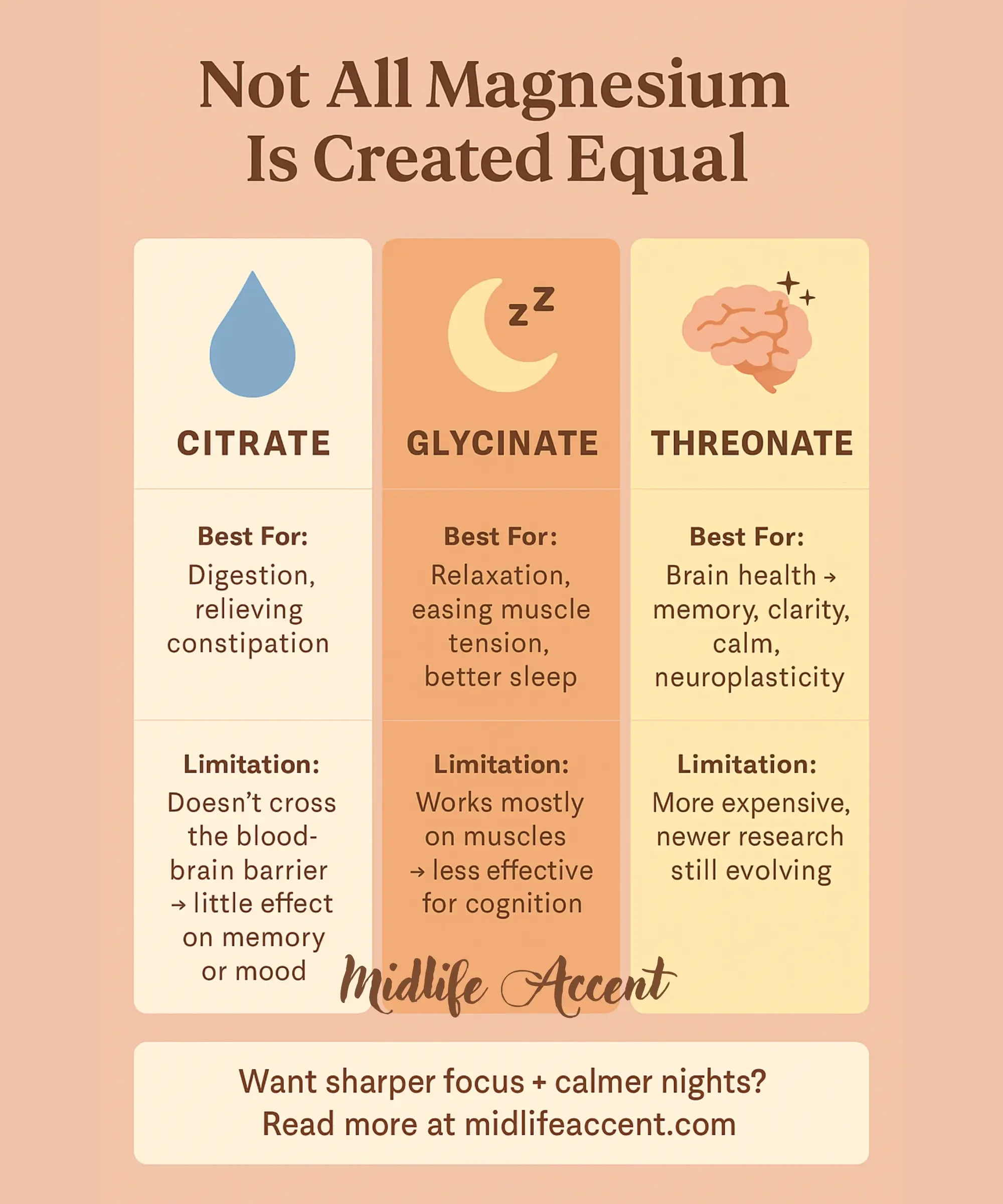
| Form | Best For | Limitation |
|---|---|---|
| Magnesium Citrate | Digestion, relieving constipation | Doesn’t cross the blood-brain barrier → little effect on cognition |
| Magnesium Glycinate | Relaxation, easing muscle tension, stress support | Works mostly on muscles and nervous system → not as targeted for memory/learning |
| Magnesium L-Threonate | Brain health: memory, clarity, focus, calm, neuroplasticity | More expensive, newer supplement → human research still limited |
FAQ
Q1. Is Magnesium Threonate safe to take long-term?
A. Most research suggests it’s safe at recommended dosages. Like any supplement, long-term use should be discussed with your healthcare provider, especially if you take medications or have health conditions.
Q2. When’s the best time to take Magnesium Threonate?
A. Many people take it in the evening, since it supports relaxation and memory consolidation during sleep. If you prefer, you can split the dose — half in the morning, half at night.
Q3. Can Magnesium Threonate help with anxiety or depression?
A. I read a preliminary research that shows Magnesium L-Threonate may support emotional resilience, reduce stress responses, and promote calmness. However, I don’t think it’s a replacement for therapy or medication. They need more human studies.
Q4. What’s the difference between Magnesium Threonate and Glycinate or Citrate?
Citrate → best for digestion and relieving constipation.
Glycinate → great for muscle relaxation and sleep.
Threonate → unique for crossing the blood-brain barrier to support memory, clarity, and calm.
Q5. Can I combine Magnesium Threonate with other forms of magnesium?
Yes — many people use Threonate for brain health while also taking Glycinate or Citrate for body support. I would keep an eye on total magnesium intake to avoid overdose.
Power Your Mind, Fuel Your Future
I use Momentous Magnesium Threonate because helped me support my mental sharpness and clarity required to live a beautiful productive life.
Subscribe to our newsletter to get exclusive content
Disclaimer: This post is based on my personal experience and is intended for informational purposes only. It does not constitute medical advice, diagnosis, or treatment. Always consult with a qualified healthcare provider before starting any new supplement, especially if you have any medical conditions, are pregnant or nursing, or are taking medications.
Affiliate Disclaimer: This post has affiliate links, which means I may earn a small commission, at no extra cost to you, if you choose to make a purchase through them. I only recommend products I truly love, trust, or have personally used. Your support helps keep the Vault growing and the coffee flowing. Thank you!
